
Kitchen cabinet hardware: hinges, drawer runners and lift systems
Kitchen cabinet hardware comes down to three choices: the hinge follows how the door sits on the carcass, the drawer runner the cabinet depth and load, and the flap lift the flap’s power factor. Drilling sizes, loads and forces come from the manufacturer’s catalogue, so this guide also shows how to read one and ends with a map of the holes.
Handles, gola profiles and push-to-open are covered in Handleless kitchen, and legs and hanging wall units in Standard kitchen cabinet dimensions.
Which hinge for which door
 Academy lesson 2.1HingesWatch the lesson →
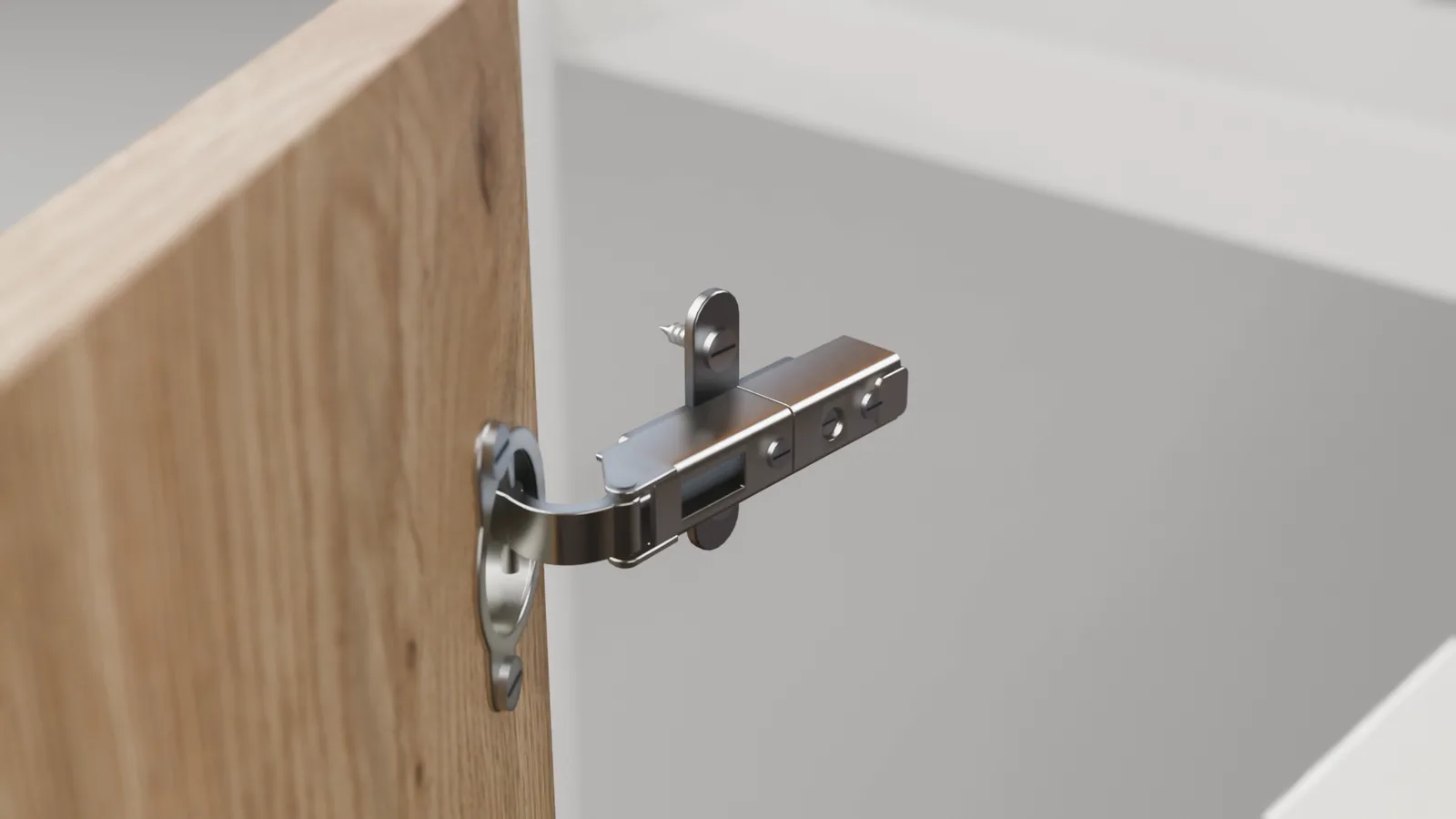
A hinge for panel furniture has three parts. The cup goes into a hole in the door, the arm carries the door and swings it, and the mounting plate is fixed to the side panel.
The door decides the hinge, not the other way round. There are three types:
| Door | How it sits on the carcass | Hinge arm |
|---|---|---|
| Full overlay | Covers the front edge of the side panel. The usual case in a kitchen. | Straight |
| Half overlay | Two doors share one middle side panel, and each covers half of its edge. | Cranked |
| Inset | Sits inside the carcass, flush with the front edge. | Cranked |
The difference is in the arm, so decide how the doors sit before you order the hinges.
The 35 mm cup, the cup distance and the plate
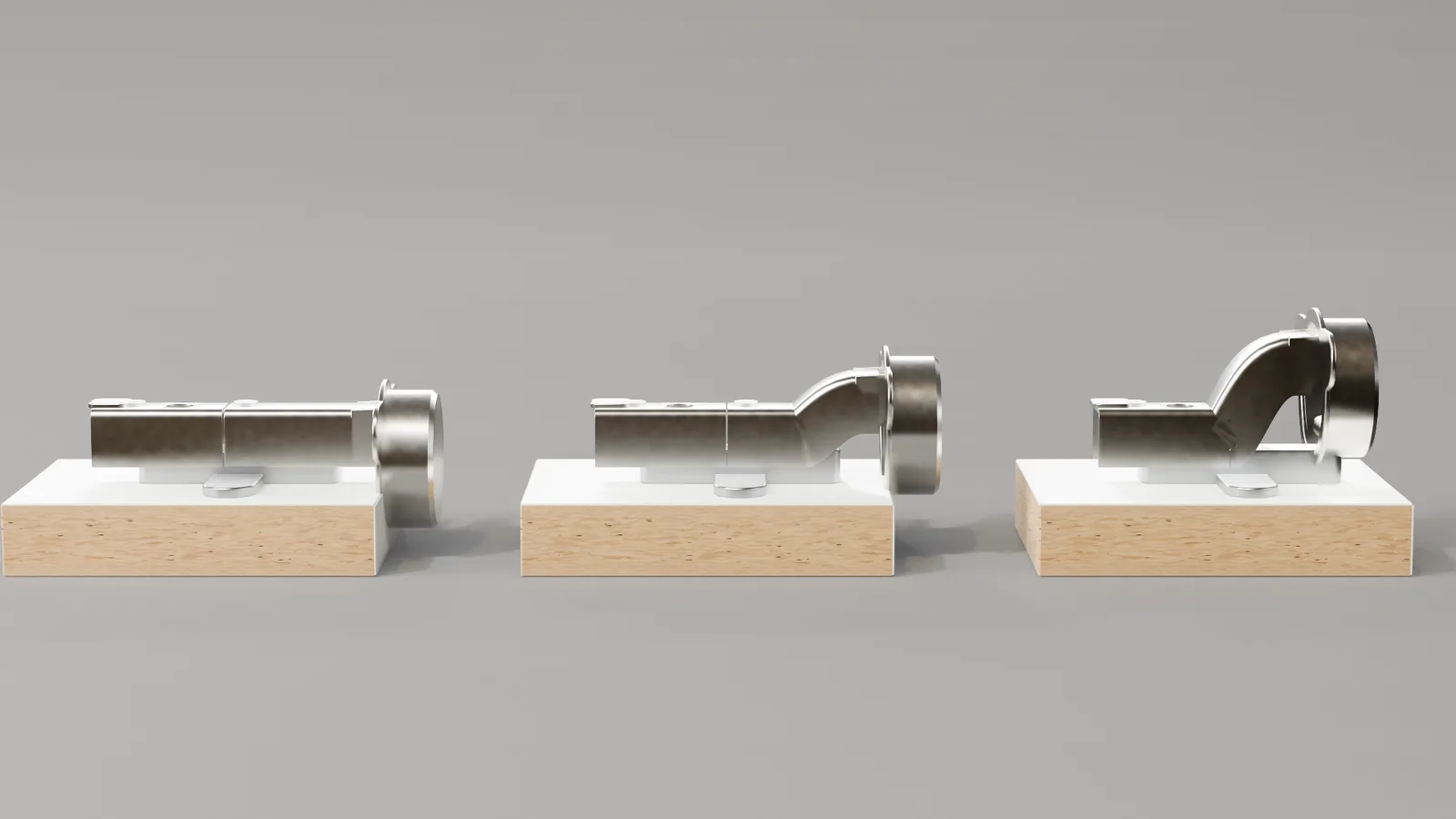
The cup goes into a 35 mm hole drilled into the inner face of the door. The hole is about 13 mm deep, so an 18 mm door still has 5 mm left under it. Drill it with a flat-bottomed bit, on a pillar drill, with a jig or on a CNC: a freehand drill easily goes in at an angle.
The distance from the door edge to the centre of the cup is the cup distance, often marked K. On many hinges it is 21.5 mm, so the edge of the hole is only 4 mm from the door edge. Some hinges use 22 mm, so drill to the table of the hinge you are actually fitting.
Together with the mounting plate, the cup distance sets how much the door covers the side panel. For a different overlay you change the plate, not the hole in the door. The plate is fixed to the inner face of the side panel, 37 mm from the front edge, with two screws 32 mm apart.
Watch out for thin fronts: a 13 mm cup in a 15 mm front leaves only 2 mm, so use a shallower cup or a thicker board.
Opening angle, soft close and how many hinges
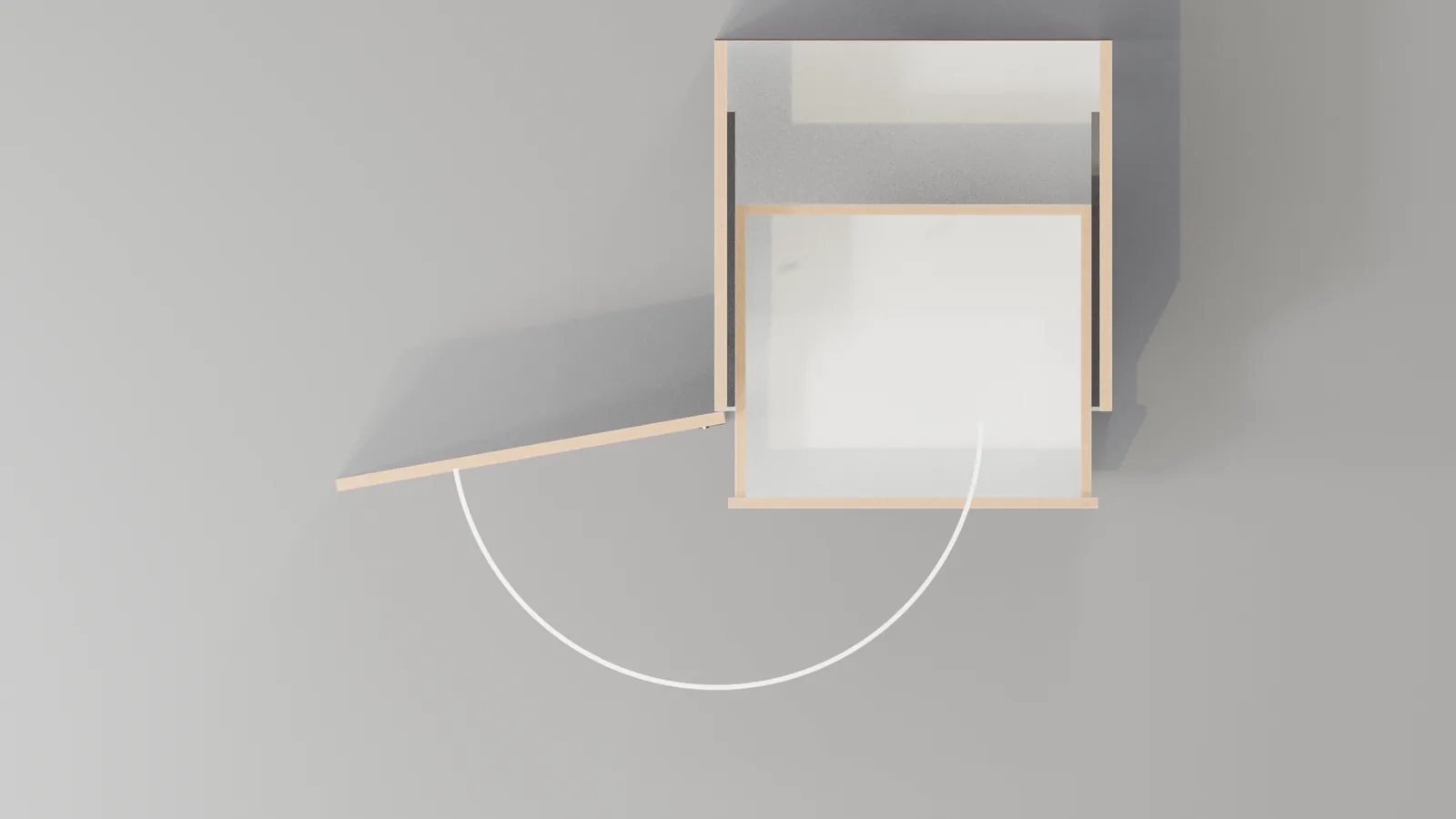
A standard hinge opens the door to about 110°. For corner units and drawers behind doors there are wide-angle hinges, up to 170°, so the drawer can come out without hitting the door. A door next to a wall or a tall unit opens less than the hinge allows, so a filler goes in between. More on that in Corner kitchen cabinets.
Soft close slows the door over the last few centimetres, so it does not bang against the carcass. The damper sits in the hinge or is a separate part on the side panel.
The number of hinges depends on the door’s height and weight. By height, the usual rule is:
| Door height | Hinges |
|---|---|
| up to 900 mm | 2 |
| 901–1600 mm | 3 |
| 1601–2000 mm | 4 |
| over 2000 mm | 5 |
Heavy or wide doors, for example with glass or in solid wood, need more, and the manufacturer’s table gives the exact number. The first and last hinges sit about 10 cm from the top and bottom of the door (96 mm in EFS), with the others evenly spaced between them.
Hung doors rarely line up by themselves, so a hinge adjusts in three directions: sideways, in depth and in height (on the plate). Adjust all the hinges of one door the same way, or the door twists. A screw at the end of its travel with the gap still uneven usually means a drilling fault.
Drawer runners: ball-bearing, concealed or a box system
 Academy lesson 2.2Runners and drawer boxesWatch the lesson →
The runner, also called a drawer slide, decides whether a drawer full of pots stays smooth and quiet for years. There are three types:
| Type | Where the runner sits | Drawer box | Hole row on the side panel |
|---|---|---|---|
| Ball-bearing | On the side of the box. Visible when the drawer is open. | Wooden, the inside width minus two side gaps | Halfway up the drawer side |
| Concealed | Under the bottom. Hidden, usually with full extension and soft close. | Wooden, with a notch at the back and a raised bottom | Just above the bottom edge of the drawer side |
| Box system | Under the box, in a kit with metal sides | Only the bottom and back are cut from board | Just above the bottom edge of the drawer side |
A ball-bearing runner needs a side gap between the box and the side panel. In EFS the default is 10 mm per side, and the runner’s catalogue gives the exact size. Too small a gap and the drawer sticks, too big and the runner cannot be fixed.
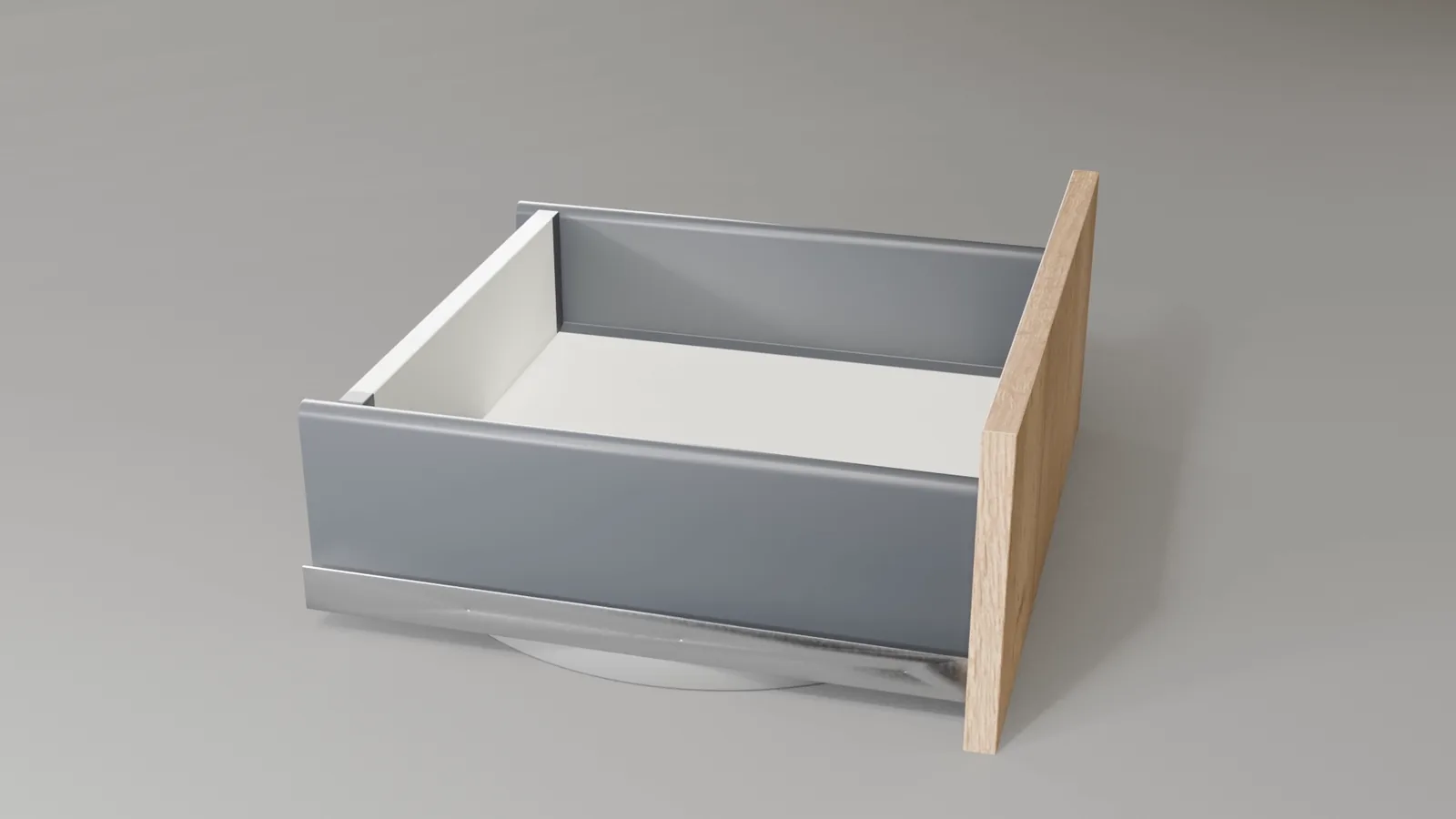
With a box system you buy the sides and cut only the bottom and back from board. Their sizes come from the manufacturer’s formula, which starts from the inside width and the runner’s nominal length. With one system, for example, the bottom is the inside width minus 75 mm.
Runner length and load capacity
A runner’s length is its nominal length (NL). Runners come in steps, usually of 50 mm: choose the longest that fits the inside depth of the cabinet, from the front edge of the side panel to the back.
The back changes that size. A 580 mm deep cabinet with a lay-on back gets a 550 mm runner. If the back sits in a groove, set in from the back edge, the inside depth is smaller and only a 500 mm runner fits.
Load capacity is in the catalogue: drawers for pots and plates take a stronger version, cutlery and towels the basic one. Partial extension leaves part of the drawer inside, while full extension brings it all the way out. For bottom drawers with pots, full extension is almost always the better choice.
Flap lifts: choosing the force by the power factor
 Academy lesson 2.3Flaps and lift systemsWatch the lesson →
A flap is a front that opens upwards. On hinges alone it would fall back, so it needs a lift fitted to the side panel. Lifts differ in how they move the flap:
- A stay lift swings the flap up around its top edge, so it stays above the cabinet at an angle.
- An up-and-over lift raises the flap and swings it over the top of the cabinet.
- A parallel lift raises it straight up.
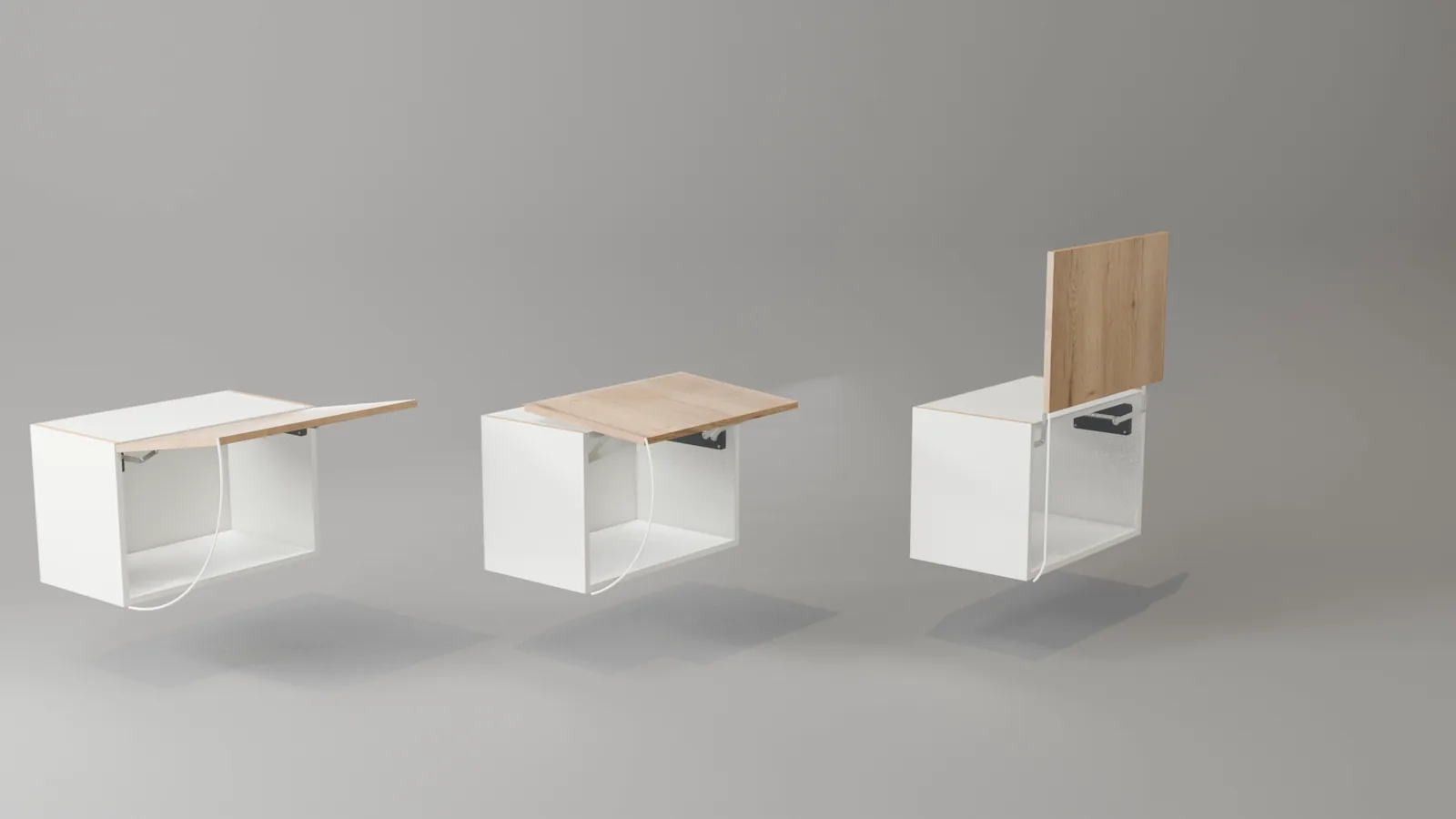
Each lift is made for a range of flap heights: small stay lifts for low flaps, up-and-over and parallel lifts for taller ones.
The force you need is set by the power factor: the flap height in millimetres times its weight in kilograms. The weight comes from the dimensions and the board density, about 750 kg/m³. An example:
- A 596 × 396 × 18 mm flap weighs about 3.2 kg.
- The power factor is 396 × 3.2, about 1260.
- In one stay lift’s catalogue, force 1 covers 400–1000 and force 2 covers 750–1500. A power factor of 1260 falls into force 2.
A handle adds a little weight. Too weak a lift lets the flap slowly drop, and too strong a lift makes it fly open by itself. Glass and solid wood flaps are heavier, so work out the power factor for each flap.
The manual chapter Wall units, tall units and flaps lists lifts with their ranges, but these are examples: order from the current catalogue.
How to read a hardware catalogue
Everything above comes from the manufacturer’s catalogue, for example Blum’s or Hettich’s. You need four things from it (lesson 2.6):
- The drilling table tells you where to drill and how deep. For each hole it gives the diameter, depth, distance from the edge and spacing, sometimes also the height.
- The overlay table tells you how much the door covers the side panel with a given cup distance and plate. A different overlay comes from a different plate, not a different hole.
- Installation dimensions tell you how much space the hardware needs: the inside depth for a runner, the inside width for a box drawer or the flap height for a lift. Check them before cutting, not during fitting.
- The article code is the name you order by. It holds the variants: opening angle, crank, soft close, runner length or side height. One different character is a different part, so copy it letter by letter.
Catalogues change: new models, different forces, different dimensions. Check the sizes and codes in the current catalogue before you order, not in an old PDF or in this article.
Where the holes go for hinges and runners
A base unit’s side panel can have several dozen holes on its inner face: for hinge plates, runners, shelf pins and joints. They are all measured from the same edges, and the front row is 37 mm from the front edge (lesson 7.3). Hinges, runners and shelves share the 32 mm grid covered in Cabinet joints and the 32 mm system.
A hinge is drilled as a pair: the cup in the door and the two plate holes in the side panel, at the same height. The arm runs level, so a plate drilled too high or too low moves the door, and adjusting the hinge only fixes a little of that. The plate holes are 16 mm above and below the hinge height. Many hinges also have two smaller holes for the cup screws next to the cup.
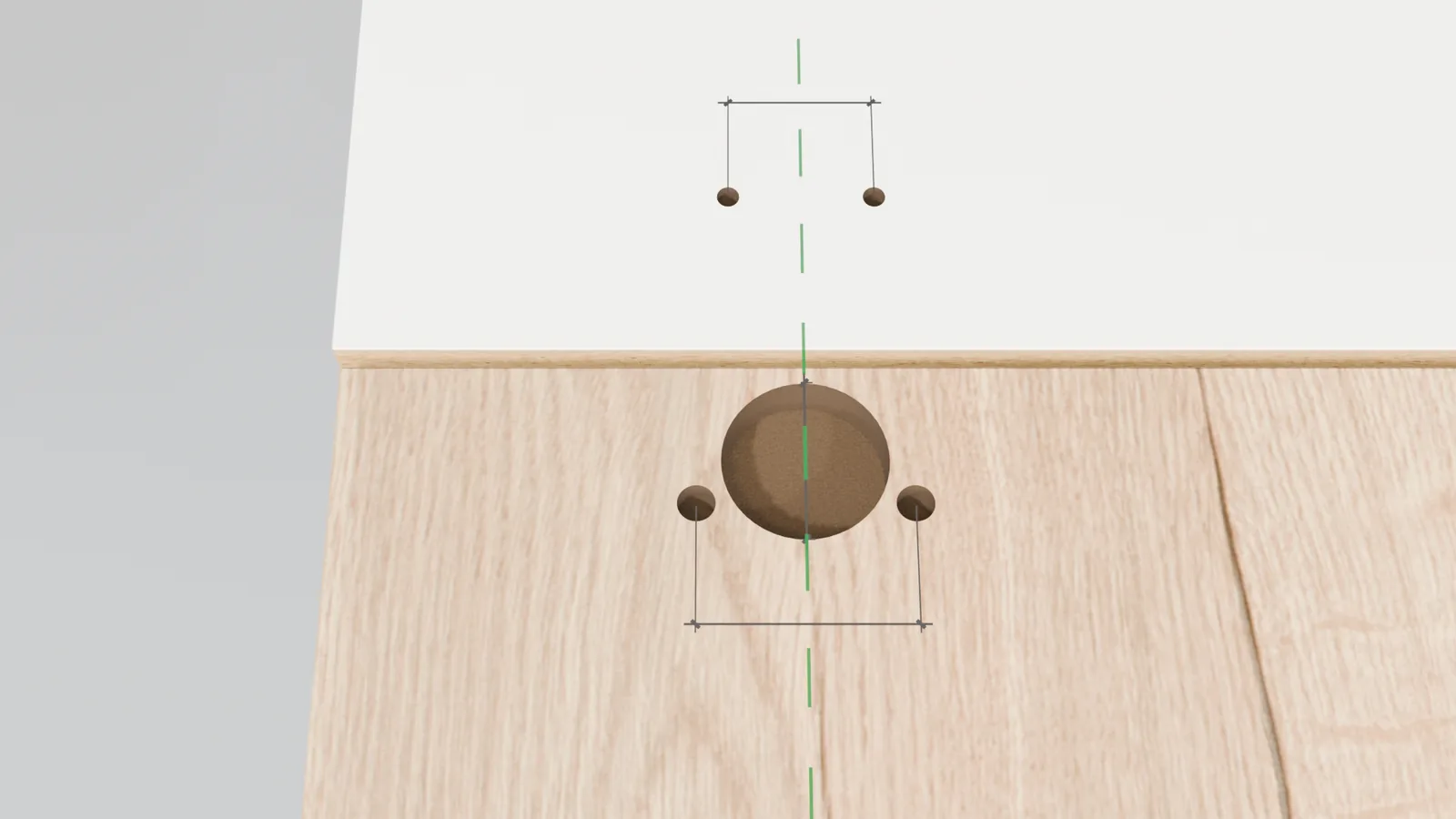
A runner has its first hole 37 mm from the front edge of the side panel and the others at the catalogue spacing, for example every 128 mm. The height of the row depends on the drawer front and the type of runner. The left and right rows must be at the same height, or the drawer runs crooked and sticks.
Holes must not clash. When a hinge plate would land on a fixed shelf, the hinge moves one step of the grid, 32 mm, on the door and the side panel together. A shelf pin hole next to a runner or plate hole is left out.
Transfer the sizes from the same edges: the front edge for depth, the bottom edge for height. Draw the door and the side panel together, and mirror the drawing for the other side panel. Drill a test piece before a series and fit the real hardware: if something is off, the fix costs one board, not the whole kitchen.
Frequently asked questions
How many hinges does a kitchen door need?
By door height: two up to 900 mm, three up to 1600 mm, four up to 2000 mm and five above that. Heavy or wide doors need more, and the manufacturer’s table gives the exact number.
Do Blum, Hettich and other hinges use the same drilling sizes?
Not always. A standard hinge cup takes a 35 mm hole, but the cup distance and depth differ. In the EFS hardware catalogue the Blum Clip top 110 has a cup distance of 21.5 mm and the Hettich Sensys 110 has 22 mm, and some hinges have a 12 mm deep cup instead of 13 mm. Drill to the table of the hinge you actually fit.
Why does my flap drop or fly open by itself?
The lift force does not match the flap: too weak and the flap drops, too strong and it rises by itself. Work out the power factor, the flap height in mm times its weight in kg, and choose the force whose catalogue range contains it. Many lifts also have a screw to fine-tune the force.